
When Ellie Steiner says something didn’t feel right when she started her college career America, she doesn’t mean she was lost. On paper, everything was right.
She had come to Israel at 17 to learn at Darchei Bina Seminary. She returned to the U.S. and began studying pre-health sciences at a religious college near her home in Baltimore, a school that integrated Judaism into academics. She was doing exactly what she had planned to do.
And yet, something didn’t sit right.
During her first year of college, Ellie came back to Israel to visit her brother, who lives here with his family. Something shifted and she felt reconnected.
She returned to the States and was speaking to her brother on the phone and asked him, “Why do I live here?” He answered simply: “You can do something with this feeling, or you can continue living your life as it is.”
A week later, at 18 years old, Ellie booked a ticket and made aliyah.
Settling In and Looking Ahead
Because Ellie was born in Israel, the bureaucratic process was smooth. She initially lived with her brother, then got her own place and began working. She didn’t yet know what her next step would look like, but she knew she was staying.
Then she heard about a new program opening at JCT (Jerusalem College of Technology) – Tal (women’s campus). Ellie reached out to the campus coordinator and was told the program wasn’t officially launched yet, but they would keep her posted.
There was one hurdle. Her senior year of high school had been during COVID, and she never took the SAT. She needed an entrance exam score. Instead of the full psychometric, she chose to take the TIL exam, which is more logic- and pattern-based and less math-heavy, and better aligned with the knowledge she already had.
She applied. She was accepted.
And she became part of the very first cohort of the transitional nursing program at JCT – Tal.
Building a Foundation Academically and Personally
The first year focused heavily on prerequisites: anatomy, physiology, math, biology, and biochemistry, alongside intensive ulpan to strengthen Hebrew.
Most of the students had Hebrew backgrounds from day school, but speaking confidently was another story.
“Hebrew is hard and scary,” Ellie admits. “I’ll probably always sound a little American.”
In the second semester, they began practical applications, including nursing interventions and hands-on training.
By second year, first semester, they were studying surgery, internal medicine, and pharmacology in English, while volunteering at Shaarei Zedek Hospital to build real-world experience and medical Hebrew through ulpan.
After passing the Hebrew proficiency test, students transition into full Hebrew coursework and begin their hospital internships.
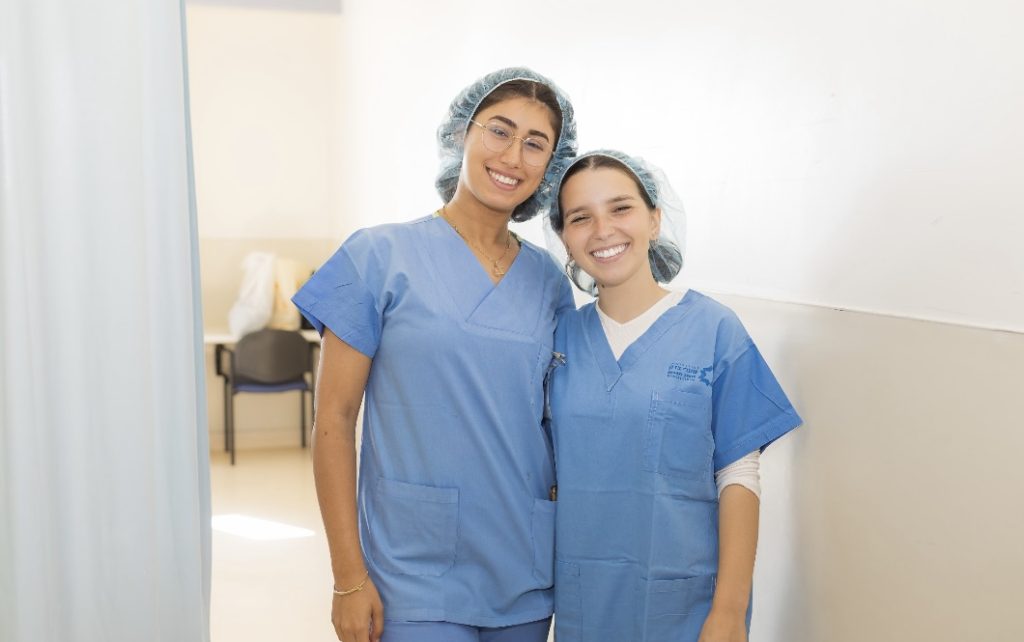
Ellie’s cohort has around 25 women. Some came straight from seminary. Others were pursuing nursing as a second career, the “moms of the group,” as Ellie affectionately calls them. Many of the younger women do not have extended family nearby, and the cohort became its own support system.
With JLIC programming, Shabbatons, and Judaic classes tailored to healthcare, such as end-of-life ethics and the laws of Shabbat in hospital settings, Ellie feels she does not have to choose between a career she loves and her Judaism.
“I can go into a career that I love and also be supported in my Judaism.”
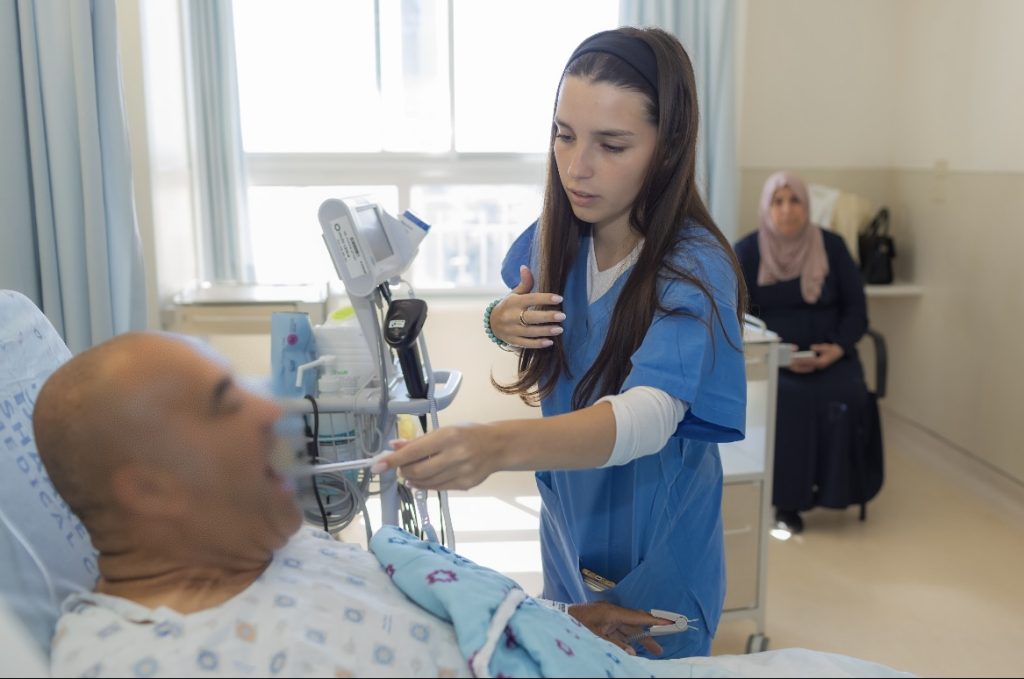
Why Nursing?
For a long time, Ellie imagined herself as a surgeon. But she also imagined herself as a wife and mother, present and involved in her children’s lives.
Nursing offered something different: deep medical knowledge combined with hands-on care.
“I love learning about the body. I love caring for people. I come from a big family. It feels natural.” She is drawn to the NICU or PICU, intensive care units for newborns and children.
“I want to help them live. I want to see them go on and have full lives.”
The ICU environment energizes her. It is fast-paced and complex. Every case is different. You see a little bit of everything.
A Family Story Coming Full Circle
Ellie now lives in Nachlaot. Her family has since made aliyah as well and lives in Beit Shemesh.
Recently, her family received letters written by her great-grandmother, who made aliyah shortly after the State of Israel was established and worked for KKL. In one letter to relatives back in New York, she wrote: “Religion here isn’t practiced once a week. It’s lived every day.”
Ellie feels that truth now in her own life. “No matter where I’m walking, I have something in common with the person next to me. Even when we argue, at the end of the day, we’re family.”
And she sees that same spirit in her class, with women from different backgrounds supporting one another as they build lives here.
At 18, she decided not to ignore a question that wouldn’t leave her alone.
Today, she is building a life in Israel that answers it.
To learn more about programs at JCT-Tal and about Jewish life with support from JLIC, visit us here.