
Finding the Right Fit: How Shira Finkelstein Found Her Place in Occupational Therapy
For as long as she can remember, the idea of living in Israel sat quietly in the background of Shira Finkelstein’s life. “It was always in the back of my head,” she says. “Even from Grade 10.”
That was when she came to Israel on a school trip. She had visited before, but something about that experience stayed with her when she returned home to Johannesburg and continued studying at Yeshiva College.
“That was when the seed was planted that maybe I’d live here one day.”
At the time, though, it still felt far away. By the time she reached gap year, the dream was there, but the logistics felt overwhelming. “I didn’t know how I would manage to study in Hebrew,” she explains. “It was a dream, but it didn’t seem realistic.”
When Gap Year Changed Everything
Everything shifted during her gap year program, which had a strong aliyah focus and exposed students to different opportunities for building a future in Israel.
“That was when it became realistic. They showed us what existed after gap year.”
One path that immediately stood out to her was Sherut Leumi, which offered an opportunity to integrate into Israeli society while exploring different career paths.
Shira began her Sherut at Sheba Medical Center. Healthcare had always interested her, and she admired the medical staff around her. “I always wanted to work in a hospital,” she says. “And I still do.” But as meaningful as the experience was, she realized she was still searching for the role that felt right for her personally.
That realization led her to switch placements and begin working at ALUTaf with children on the autism spectrum, a move that would ultimately shape her entire professional direction.
Discovering Occupational Therapy Up Close
“At ALUTaf, I was exposed to physiotherapy and occupational therapy up close for the first time. And I loved how they combined holistic healing with physical healing.”
Watching therapists work with children through stages of growth and rehabilitation changed the way she thought about healthcare.
“You work alongside the patient. It connects both the body and the mind. That combination really resonated with me. The nurses in the hospital were amazing, but when I saw OT, it felt more like what I wanted.”
That clarity pushed her toward occupational therapy studies, though getting there was not simple. Shira was determined to study in Hebrew, but the admissions process proved exhausting. “Trying to pass the Mivchan Yael (Hebrew proficiency test) was really difficult,” she says. “And I felt like I was constantly chasing people at the universities for answers and never hearing back.”
Eventually, she heard about Ono Academic College’s new international school, whose OT program would now offer students the chance to begin in English and gradually transition into Hebrew.
“I said, this is perfect,” she recalls. “At Ono, they were so responsive and supportive. It felt like they really cared.”
Building a Life as an OT Student
Now in the program, Shira describes the workload as intense, especially combined with ulpan studies. “The hours are crazy,” she laughs. “But the ulpan has been really important.”
More than that, she says the atmosphere has helped make the adjustment easier.
“The teachers and peers are great. It feels very family-oriented. JLIC’S Yaeli and Yoni Davis have also created a support system for us beyond academics. They really check in on us. And if we have a gap in the day, they’ll organize something like a Pilates class or lunch. It’s nice having people you can turn to.
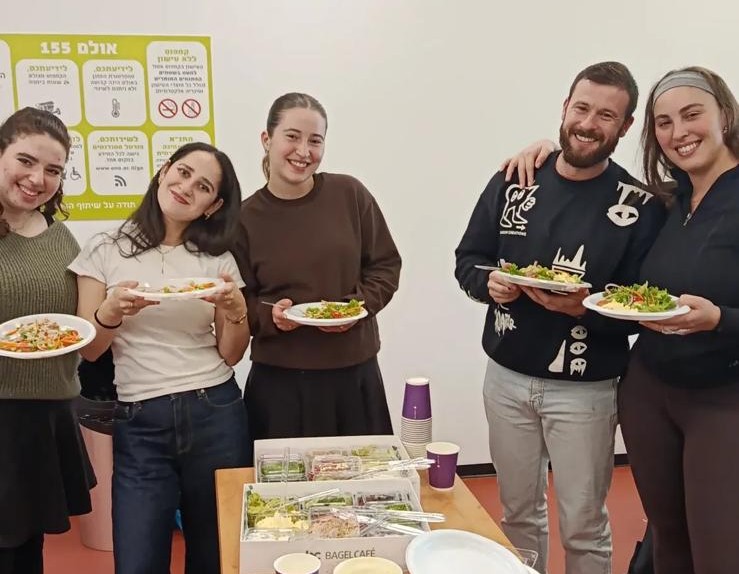
Shira, second from left, enjoying a lunch break with JLIC
Although she has not yet started full clinical placements, Shira is already gaining hands-on experience through volunteer work that counts toward her clinical hours. She currently volunteers with a young girl with autism while other students work with elderly populations in different settings.
“It’s helping us get familiar with working with people in different stages of life, even though we aren’t yet practicing occupational therapy in our settings” she explains. Clinical visits have also given students exposure to a range of workplaces and patient environments ahead of their formal placements next year.
Finding a Way to Contribute
What excites Shira most about occupational therapy is how broad the field can be. “I tell everyone it’s the best degree, and I’m only one year in,” she says. “You can do so many things with it.”
She speaks about rehabilitation work with particular interest, especially helping patients adapt after life-changing injuries.
“If someone has an amputated leg and can’t walk, you help them learn how to function again. You teach them how to use adaptive devices and adapt their lifestyle to a new disability.”
While she is still discovering which area of occupational therapy she wants to pursue, she sees that as one of the profession’s greatest strengths. From working with children to supporting older adults, injured soldiers, and people navigating major life changes, the possibilities are wide-ranging. “I still need more exposure,” she says, “but that’s what I’m excited about.”
What began as a passing thought on a Grade 10 trip has grown into a career path, a community, and a life in Israel. As she continues to explore the many possibilities within occupational therapy, she has already found something meaningful: a way to combine her passion for healthcare with a desire to contribute to the country she now calls home.
To learn more about campus life at Ono Academic College, visit us here.